
Hands on with John the Ripper: Performing a Basic Dictionary Attack
Hands on with John the Ripper: Performing a Basic Dictionary Attack#
In a previous article we discussed techniques and tools used for cracking password. In this article, we provide a step-by-step guide to performing a dictionary attack with one of these commonly used tools, “John the Ripper”.
Task 1- Display your current wordlists in your Kali.
As you already know Kali has several built-in wordlists and we have covered this concept in the previous blog pages. Let’s run the following commands to display current wordlists:
cd /usr/share/wordlists
ls -l
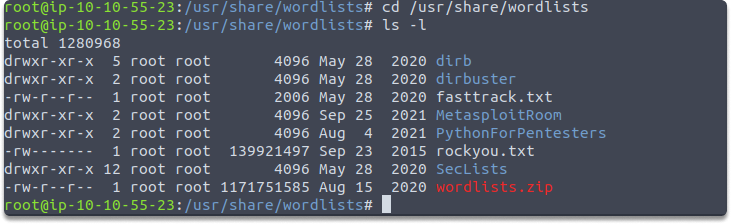
Task 2- What is the flag in John which enables you to read words from file?
We can learn this by running the following command:
john -h
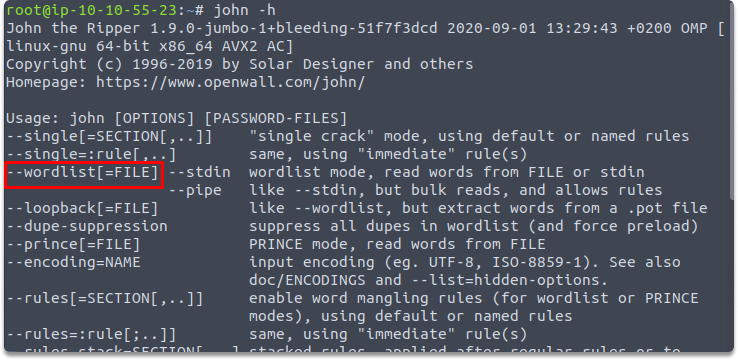
Task 3- What is the password hash of the user crackmypassword.
We can display the hash of the specified use by running the following command:
cat /etc/shadow

Task 4- Save the password hash of the user crackmypassword in a .txt file and name it crackmypasswordhash.txt.
We can achieve this in many ways such as running the following commands:
First copy the hash of the specified user and run vi crackmypasswordhash.txt
Now we have both a dictionary and a target password hash.
A quick look at John syntax
Now let’s have a look at John’s Syntax:
john [options] [path to file]
John needs options that should be followed by the path to the name of the file if it is not in the same directory.
Defining the flag:
--wordlist=/usr/share/wordlists/rockyou.txtInvoking John:
john,Specifying file:
[path to file]is the file or path including the hash you’re targeting. However, if it’s in the same directory you won’t need to name a path, file name is sufficient.
Task 5- What is the password of user crackmypassword?
We are going to use rockyou.txt as a dictionary. So the whole command would look like the following:
john --wordlist=/usr/share/wordlists/rockyou.txt crackmypasswordhash.txt

The screenshot below demonstrates how John the Ripper was able to detect the password hash from the rockyou.txt wordlist. While employing a directory-based attack with a wordlist is, we can only be successful if the password exists in the wordlist. Since this is a super easy one we did not need any other wordlist to recover the password.
Final Words
Congratulations! Now you know how to perform a basic dictionary-based attack with John.
See also
Looking to expand your knowledge of penetration testing? Check out our online course, MPT - Certified Penetration Tester